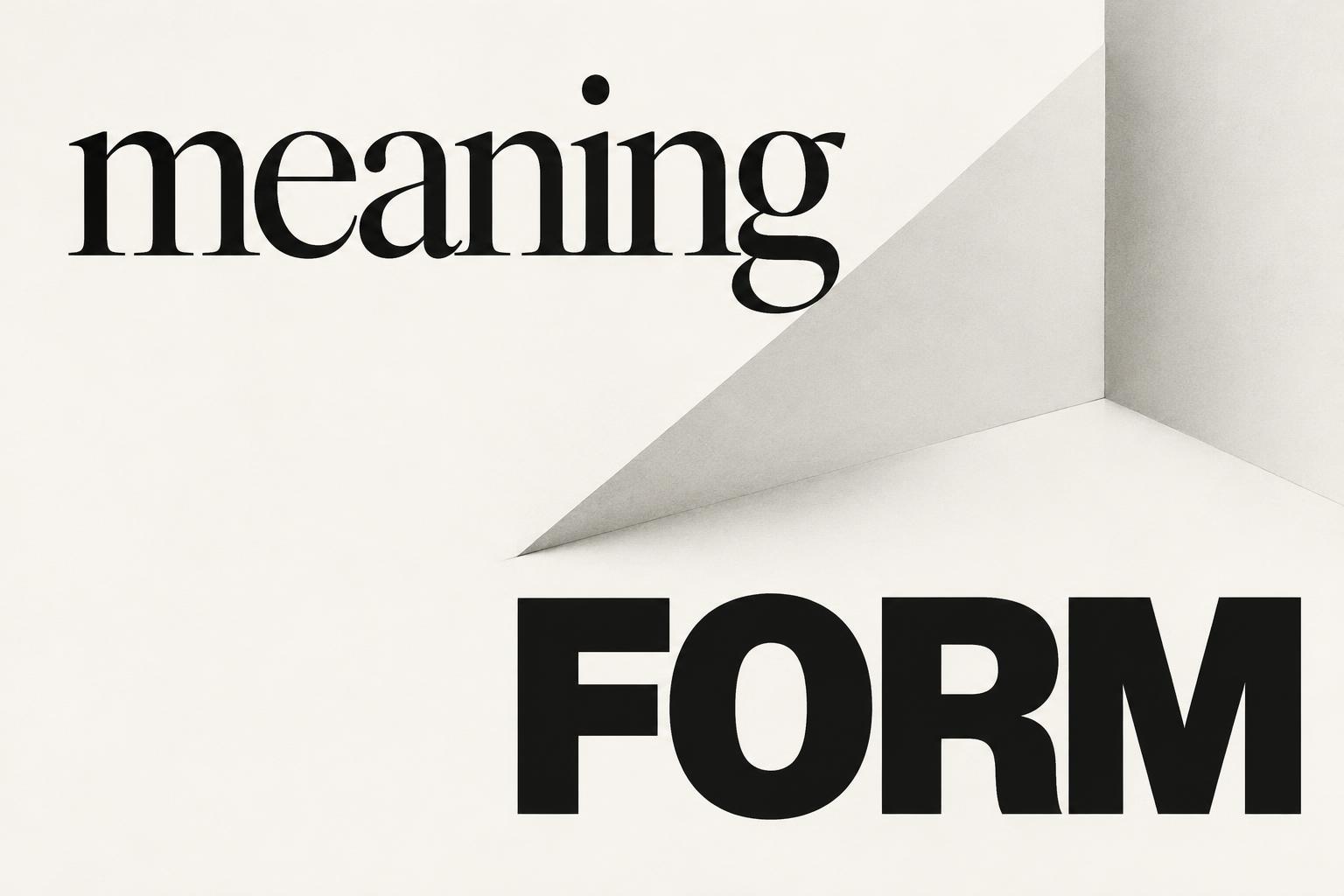
A strong brand does not start with its surface. It starts with the question of what it stands for.
We live in a time of nearly unlimited creative possibilities. Identities can be developed within a few days, visual worlds generated with artificial intelligence within minutes. New typefaces, colors, images and digital experiences emerge faster than ever before.
And yet it has not become easier to build a relevant brand. On the contrary. The more design becomes available, the more important the question of what it is actually meant to express.
Because a brand is not what a company designs. It is what people think, feel, remember and expect about it. In practice, however, this distinction is often overlooked.
Confusing identity with appearance
When organizations notice that their brand is losing relevance, the change often begins with what is visible. The logo is modernized. The color palette reworked. A new visual language developed. The website redesigned.
All of that can make sense. It just does not automatically solve the underlying challenge. Because when it is unclear what role a brand plays in people's lives, even the best design will not answer that question.
A rebrand can generate attention. But attention alone creates neither understanding nor trust.
The real strategic work begins earlier: with identity, business model, positioning, social and cultural context and the experiences people have with an organization.
A visual identity is the translation of these decisions. Not their substitute.
What brand science says about it
Research from the Ehrenberg-Bass Institute for Marketing Science offers an important shift in perspective. Brands exist not solely through their messages but through mental availability. What matters is whether people think of a particular brand in relevant buying or decision situations.
This happens, among other things, through recognizable brand elements, associations built up over the long term and the connection to concrete needs. Colors, shapes, signs and verbal codes can be valuable, not because they are beautiful but because they are recognized and remembered.
Here lies the difference between good design and effective brand management: design can enable recognition. Brand strategy decides what that recognition should stand for. Both belong together.
A purely aesthetic overhaul that carelessly abandons existing recognition features can weaken accumulated brand equity.
The cultural dimension of the brand
Brands do not emerge in a vacuum. They are part of cultures, social relationships, economic developments and societal perceptions. What one generation considers modern can seem arbitrary to another. What creates trust in one market can create distance in another.
That is why it is not enough to observe design trends. We need to understand why they emerge.
The Adobe Creative Trends Report 2026 describes multisensory experiences, emotional connection, cultural authenticity and partly surreal design as creative directions.
Behind this, I see a contradiction. While AI dramatically accelerates visual production, the need for human experience, cultural grounding and emotional meaning is growing at the same time.
Not every generated image creates connection. Not every design innovation is relevant. And not every brand needs to adopt every trend.
Which cultural development is meaningful for this particular brand?
Meaningful difference instead of interchangeable perfection
Kantar Media Reactions 2026 addresses changes in brand communication. People encounter brands on platforms, through creators and through AI-driven information systems. This creates new requirements for recognizability, relevance and credibility.
The following connection between human perception and machine comprehensibility is my own strategic conclusion, not a direct study finding and not a "meaningful difference" claim attributed to the report.
A brand must be understandable to people while also being clearly describable and classifiable in digital, increasingly AI-mediated contexts. But technical discoverability is not enough. Without a recognizable distinctiveness, structured data alone has limited effect.
This is where human perception and machine comprehensibility connect. A future-ready brand needs an identity that means something to people, and a structure through which digital systems know what it stands for, what it offers and who it is relevant for.
The most important question comes before design
When I work on a brand, I am not interested first in what it should look like. I am interested in what it wants to achieve.
Which tension in the market does it resolve? Which needs does it understand better? Which stance determines its decisions? Which experience should people associate with it?
Only then does design unfold its strength. A color palette becomes a distinctive code. Typography becomes an expression of personality. A message becomes a promise. Touchpoints become a coherent brand experience.
My perspective
I consider design one of the most important forms of expression for a brand. But strong brands do not arise from design alone. They arise from identity, strategy, culture, behavior and experiences.
Not every brand needs a societal purpose. Its meaning can be solving a problem better, being reliably available or bringing people joy. What matters is the recognizable connection between promise and actual experience.
A brand is not a design problem. It is a strategic and cultural design task. And good design makes that task visible.
Sources & context
- Ehrenberg-Bass Institute (opens in a new tab)
Research foundations on mental availability and recognizable brand elements.
- Adobe Creative Trends 2026 (opens in a new tab)
Creative trend directions as cultural orientation, not as scientific proof of effectiveness.
- Kantar Media Reactions 2026 (opens in a new tab)
Media and communication context. The connection to machine comprehensibility and "meaningful difference" is an independent strategic interpretation.
- WARC · Creativity with Impact (opens in a new tab)
The linked article "Creativity with impact: long-term thinking for sustained success" is from 2024, not 2025. Further context on long-term creative impact; no figures claimed in the essay. Content may require access.